Monday, 4 November 2024

An Existential Rethink

Back in 2016, I wrote the following blog post and today I rediscovered it while looking for something else.  It surprised me how little had changed over the intervening years; and yet I was interested to realise how much my thoughts on the role of the library and librarian had not remained as I described them in the blog but had come full circle with a few major and minor tweaks.  And then there is the question of how my administration and teaching colleagues view the library today!

"I woke up in the middle of the night about a week ago and the voice in my head told me that I really needed to get rid of the majority of our periodical collection.  I told it to shut up and that everything would seem better in the morning.  Then I tried to go back to sleep.


A short while later, the voice said that I should also get rid of most of my fiction collection since hardly anyone was reading.  "Be quiet," I said.  I wanted to yell that but I didn't want to wake up the whole house.  Instead, I turned over and tried to think of something else.  "And then there's the non-fiction collection!"  I didn't have to listen to anymore.  I was now awake.

I might have asked myself where this was all coming from but I didn't need to.  It is something that has been bothering me for quite some time.   I told people the next day that I was suffering an overly long existential moment but that moment has turned into a week.  So, the question became this:  what is the point of the upper school librarian and the library at our school.

I hear the voices of fellow librarians and of course, I know that there is a point and I am fairly certain that I can elucidate it.  However, I don't know if anyone else can.  I might ask my colleagues what they see as the role of the library and librarian and I would get back the usual platitudes.  I have educated them well.  However, their actions don't confirm this.  The English department has stopped bringing their classes for book talks and book selection, claiming they can't afford the time.  The science and humanities departments don't come for research lessons as often as they did, giving the same reason.

Was it something that I did or didn't do?  I have spent a lot of time thinking about this.  I surveyed, I increased my book displays and bulletin boards, I have given mini workshops at staff meetings and gone to department meetings to peddle my wares.  Finally, yesterday I came to the realisation that it wasn't something I did or didn't do, that it is simply the way my school is going.

To meet the requirements of the MYP e-assessments, a lot of time given in the past to research has been cut.  I have even had someone say to me that it didn't matter to them what sources the students used and how good (or bad) they were.  Students would now only be given a short period of time in class to ask about the essay topic and then it would be due a week and a half later.  No time to come to the library, no time for me to share good resources, no time for me to assist with the development of their research skills.  And as for referencing, well who knows how that is going!  Encouraging students to use the excellent book resources we have was always a challenge.  Now, I might as well pack them up and send them off to Better World Books.

I don't want you to think that I am feeling sorry for myself or heaven forbid, wallowing in self-pity. Quite the contrary (though that might have happened for a short while), I am feeling liberated by the realisation that the needs of the school have changed and that the library and the librarian are going to have to change as well.

You may not be reading the situation right, you might say.  And that is true.  Thus, though I have decided that I will probably reduce my book stock by up to 50% (notice I'm not being totally radical), and stop subscribing to most of my periodicals, I do recognise that I could be wrong.

I wrote the following email to my senior management team:

Please excuse my existential crisis but......I was wondering what you saw as the function of the library and the librarian.  I know what I believe it should be but I was wondering about how the senior management saw it. I'm not asking for a quick reply but would appreciate you giving it some thought over Christmas and getting back to me in the new year.  I am going to ask the rest of the upper school staff to think about it as well.  I am sure that I will get the usual responses but what I would like to know is how you would like to see the library and the librarian function within the school.  Perhaps after the feedback, we could arrange to meet and discuss your thoughts and mine.

More to come!"


The reply I received was as follows:

'It may be worth posing some questions in a google form for all of the SLT and possibly HoDs if you are asking the same question of them?'

I am waiting to see if this is the only reply I receive from them.  If it is, it speaks volumes!"  (It was and it did!)


So here I am eight years later, revisiting an existential crisis that could have led somewhere significant and didn't!  Well, that probably isn't entirely true.  Nearly all of our print periodicals have gone.  However, we do have PressReader and individual digital subscriptions to the New York Times, the Economist and the Financial Times.  We also have 12 print copies a week of First News shared between the lower and upper school libraries.  As for our fiction collection, it has grown.  We have an entirely new English department and their middle school students either come in once every two weeks for book selection or every time they finish what they are reading in class. Furthermore, each teacher allows them time to read in each English period.  Our circulation has never been this good.  

And finally, there is the non-fiction collection.  I have always found this to be the most problematic part of the collection.  The books relating to particular units, are used if the teacher encourages their use or asks for them to be kept in the classroom for the duration of the unit.  Students in certain DP subjects will seek out books mentioned by their teachers or if they are encouraged to use books for their IAs or EEs.  However, they can be a hard sell.  

I have considered paring down the collection.  In fact, there was a dramatic reduction during the pandemic and which continued just afterwards when the library was divided into a fiction and non-fiction collection in two different locations.  I have integrated the reference collection (what was left of it) with the rest of the collection; I got rid of most of the dictionaries; I weeded books published before a certain date and on topics which seem no longer relevant.  And so it continues.

At the present time, I am investigating digital collections for non-fiction but so far, I have only found one which offers a wide selection of topics and it is really only appropriate for grades 10 to 12: Perlego.  Furthermore, though this is an excellent collection of over a million books, it would be cost prohibitive to provide it for every one of our upper secondary students.


Tuesday, 4 June 2024

Blog Entry 5: Perlego and its AI Researcher

 (So here I am a day late writing my next blog in my personal challenge to write every day.  It isn't that I didn't write yesterday, it's just that it wasn't appropriate for this blog!

 Yes, I am still excited about Perlego and I have spent time every day since I discovered it, exploring its possibilities.  When you start poking around, the first thing you are likely to come across is the search bar.  You can use it in a traditional manner, looking for author, title, ISBN, etc. but more exciting still, is the AI Researcher.


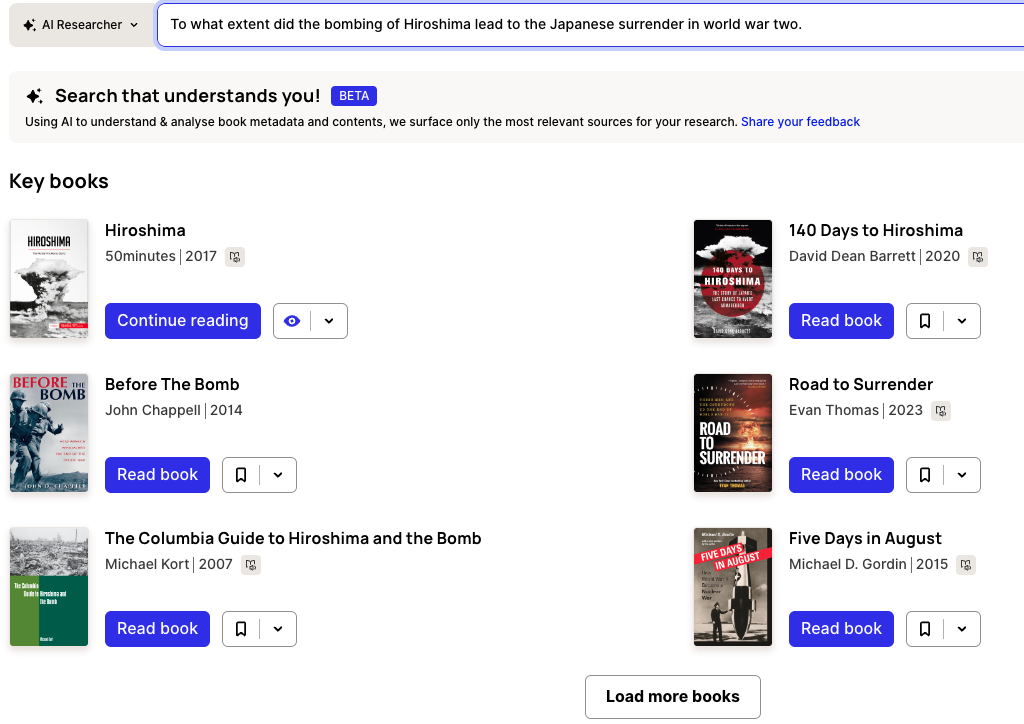
I experimented with a research question and with key words and both were effective.  Below is a sample of the research question results: To what extent did the bombing of Hiroshima lead to the Japanese surrender in World War Two?


Keyword Search


The book results vary but that isn't surprising since the keyword search wasn't as focused as the research question search.

(I may update this blog tomorrow!)


Sunday, 2 June 2024

Down Various Rabbit Holes

 I didn't write yesterday or Friday, not because I didn't have anything to discuss but because I was sucked down several rabbit holes and I still haven't really emerged.  The first was that of Perlego, which I hadn't heard of until Wednesday evening when a student emailed to ask if I could find a copy of a book called, The Oslo Accords 1993–2013: A Critical Assessment by Peter Bauck.  Well, no I couldn't, to my frustration, despite checking all my usual suspects.  Then, I alighted upon a reference to it online on a website called Perlego and down I went.  


I don't often get this excited about websites, especially ones which offer access to ebooks.  Truth be told, I don't enjoy reading online.  I do recognise all the positives of ebooks and of providing access to them for my students.  Though as luck would have it,  Perlego turned out to be far more than I could ever have expected with over a million academic non-fiction titles, appropriate for the upper secondary and the university level reader.  However, it didn't stop there.  It wasn't just the books but it was also the tools offered for interaction with those books.  (I'll list them and then discuss each later.)

  1. An AI Researcher, which doesn't offer an answer to your question but suggests books from the collection which will help to answer it, and provides key excerpts from each suggestion.
  2. A workspace for each of your topics of research 
  3. A number of tools to assist the user in accessing the books
  4. A notebook function
  5. A way of setting up an assignment and sharing it with collaborators (or students) through the workspace.  Not necessarily meant for teachers but perfect for them!
There are likely to be tools and functions I haven't discovered yet but I will keep exploring and using Perlego for my own research and to find possible books for my EE and IA students.  

In my next blog post, I will expand on each of the 5 point above.  

Thursday, 30 May 2024

Post 3: My Grade 7 (Year 8) Science Class

I wasn't thinking about using my class today as a topic for my writing exercise but the class went so well that I changed my mind.  The grade 7s have been working on a unit about the periodic table and were divided into pair groupings to complete a research project on one particular element.  Below is the information from their task sheet. (This is not included in my word count!)


Title: The Elemental Quest

Introduction:

In this project research we will embark on an exciting journey into the heart of chemistry and

its profound impact on our world. In this project, we will look into the essential building blocks

of matter: the elements of the periodic table. But we're not just exploring their scientific

significance; we're delving deeper into the catastrophic consequences that could ensue if

these elements were to vanish from our existence.

Each of your groups will embark on a research quest, assigned to investigate the importance

of a specific element from the periodic table. You'll uncover its indispensable role in various

aspects of our lives, from industry to medicine, agriculture to technology. But here's the twist:

you'll also examine the potential devastation that would unfold if this element were to

suddenly disappear from our planet.

Imagine a world without oxygen, carbon, or even something as seemingly inconspicuous as

iodine. The repercussions would be far-reaching and severe, impacting everything from the

air we breathe to the food we eat, the devices we use, and the medicines that keep us

healthy.

Through this project, you'll not only deepen your understanding of chemistry but also

cultivate a sense of responsibility towards preserving these fundamental elements. You'll

discern why it's imperative to safeguard them for future generations and advocate for their

conservation.

Get ready to unlock the secrets of the periodic table and discover the power it holds over our

past, present, and future. 


Welcome to the Elemental Quest!

Your research product could take any of the following forms:

● A story (biography or autobiography) about the element

● A children’s book about the Element

● Powerpoint presentation about the element(12-15 slides)

● The element webpage or Movie

● A poem or song about the element

● An element case file or Poster

● Collage/picture book with captions or scrapbook of element

● Interview video (Student/Scientist, Journalist/Researcher, Parent/Child, etc., )


My role in this was to take the students through the process of setting up their Works Cited List (WCL) and to introduce the research guide and the print books available from the library.  

 As I demonstrated in my account, one person in each pair group set up a WCL using Noodletools and then shared it with their teacher, their partner, and me.  Next, I introduced the libguide for the project , which acted as a jumping off point for their research.  The guide contains links to various tools such as the library database and noodletools; slide presentations on using noodletools, in-text referencing and the referencing of images according to MLA.  There is also a tab for databases, three in all.  I went through each one briefly reminding the class how to use them.  Finally there is a tab for web links.  (All of this is available by clicking on the link above.)

I am returning to the class next week to assist students, mainly with the referencing.

(I am not entirely happy with this description so I will probably edit it!)

Wednesday, 29 May 2024

 As I said in my previous post, I was involved in a writing project a number of years ago.  Today I decided to find those blog entries and read some of them.  One of them is my jumping off point for today's post:  https://kitandcaboodal.blogspot.com/2015/03/post-6-round-2-of-28daysofwriting.html.

Bear in mind that the post was written over 9 years ago, when you read what I have to say today.  I came up with a number of suggestions to improve the research stills of our students and reading over them, I realise that we have made little progress.  

First of all, I recognised that we need to work with primary students to improve their skills (and those of their teachers) so that they are prepared when they move up to secondary.  I recognise that I have partially succeeded in achieving this goal even though I may not feel that I have progressed far with it.  The grade 5s (year 6 in the UK system), spend part of their year preparing a topic for their exhibition in early May, and I work with them.  

This year the students accomplished the following:

1. Learned how a browser and a search engine work in order to better understand how to phrase our keyword searches.

2. Learned how to use some of the google operators, such as: the site operator [site:]; the range operator [air flights 1950..2020]; how to find definitions using [define:]; and how to search for particular file types [filetype:pdf]

3. Became familiar with keywords which would help them find statistical information about their topic

We also did some work on how to verify that a website/source was reliable and how to find images, charts, and graphs.

Having written this, I don't feel that we've done too badly!

(301 words)

Tuesday, 28 May 2024

7 Draft Entries and Nothing to Show for Them!

 The last 7 draft entries in my blog haven't been finished.  Realising this, reminded me of a writing project I got involved in about 6 or 7 years ago.  The idea was to write 200+ words a day, every day.  I can't remember how long we planned to do this but I managed it for a month at least.  I have several blogs so the results of this 200+ challenge must be somewhere.  However, reading them isn't the point of this entry, which I plan on finishing!  It is to set a similar challenge to anyone who is interested.  I do know that the more I write, the more I write, if you follow that.  Not only do I start to write longer pieces but they get better.  (Thank goodness, my inner voice is saying!).   

Here is what I suggest.  Commit to write 150+ words on your life as a librarian and post it on a blog, the link to which you can share in this Facebook group.  Commit to it for at least 4 days out of 7, more if you can.  Read the blogs of others and perhaps have your blog entry be a response to someone else's from time to time.

Let's start a conversation!

(208 words! Now that wasn't hard!)

Monday, 19 June 2023

A Rose by any other name…would still be a library. Or would it?

Groan!  Another article about another area of the world, this time my home base of Canada, where libraries are being reimagined and pushed into a corner; and the librarians quietly confined to obscurity.  In this article, the library has become the ‘Curiosity Space’.  I don’t know whether to vomit or…well, what?  


https://www.winnipegfreepress.com/breakingnews/2022/12/31/its-not-a-school-library-its-a-curiosity-space


Were the school libraries I have overseen, curated, loved and nurtured over the years not full of curious children and young adults, learning about the world around and within?  I shout emphatically, ‘yes, they were’!  Did these libraries not evolve over the years to meet the needs of their users?  Again, I shout, “Yes, they did!”

Do I sound frustrated?  

I think that is an emphatic "Yes," shouted to the indifferent universe!


Saturday, 11 June 2022

Why My Students Use Wikipedia

 Wikipedia has become the bugbear of teachers at many schools when it comes to student use of the internet for research.  When I started at my present school in 2009, it was obvious that my students were unlikely to give up using Wikipedia simply because we wanted them to.  The solution, I decided, was to convince them that they should not reference it and that it should only be used as a jumping off point in their research.  On our libguides, I made sure that students always received the following advice:


School Policy on Wikipedia:  Read for background but do not cite!


Rule No. 1:  Use Wikipedia as a starting point for your research, but don't cite it unless you can exhaustively demonstrate that it is the only authoritative source on a particular issue.


Unfortunately, a few students decided that the policy meant that they could use the information from Wikipedia but that they didn’t need to reference it.  Thus we added rule 2 and 3:


Rule No. 2:  Re: Rule No. 1:  That doesn't mean that you should use the information from Wikipedia anyway and just not cite it.  It means that you should find other research sources.  Encyclopedias are only meant as starting points!  For example, you could find the bibliography in the Wikipedia article and look at the sources that the author of the article used.  You could also look to see if there is a list of links.  Check those out as well.


Rule No. 3:  If you are unsure, ask your teacher or librarian!


Over the years I have become a more sophisticated user of Wikipedia.  Furthermore, I have carried out my own research into Wikipedia and its use in academic research.  I can’t say in what order any of this happened.  However, I have recently come across a number of university libguides which include information and videos on the use of Wikipedia for research; and I have used them with my senior students.


Below is an example of a video from the University of New Brunswick in Canada


I have also taken on board some of my own observations to improve how I carry out research.  Initially, I read an article for background and then checked out the references and the links.  Later, I realised that the articles often gave me search terms I could use in furthering my search for information sources.  Finally, it wasn’t till I discovered Mike Canfield and SIFT, and later the Civil Online Reasoning course from Stanford that I realised Wikipedia’s value in fact checking sources.  


And now for the ‘more’. We tell our students not to use Wikipedia and yet many teachers seem happy to accept websites which might be judged as equally or more dubious. From a recent history assignment, I found the following:


  1. https://www.history.co.uk/ :  a website originating in the United States and created by the Arts and Entertainment Network


  1. https://www.biography.com/ :  also from the Arts and Entertainment Network


  1. https://www.ducksters.com/ :  Little detail is given on the authors of the information on this website.  In their defence they do give a works cited list for some of the articles.  However, in the geography section the information source for Taiwan is over 10 years old. 


There are many websites, which student researchers come across which fall into the same category as those above. I have started to include a list of such websites on our libguides (see example below). I am hoping that teachers will also include them on the task sheets they prepare for any research assignment.


Tuesday, 7 June 2022

MYP and Research Skills


 A few weeks ago I facilitated a discussion on zoom about research skills in the MYP.  Though I had hoped for co-presenters, no-one stepped forward so much of the hour was taken up with me talking about what my IT integrationist colleague and I have started to do at our school and our future plans.  This is meant as an introduction to the recording of that session.


I have been working somewhat haphazardly over the last few years on teaching research skills to my MYP students and in developing a scope and sequence and learner outcomes for some of these skills.  I say haphazardly because, despite being a fairly effective researcher, it has taken me some time to come to an understanding of what skills beginners require, how to teach them and how to go about scaffolding those skills over a number of years so that students eventually develop into confident, effective researchers.


The covid pandemic lockdowns gave me an opportunity to step back from the hurly-burly of school life and take a good look at my practice and the needs of my students.  First, I came to the conclusion that I needed to upskill.  I needed to be better than my students and I also needed to be able to confidently meet them where they’re at.  


I know that we would all like our students to use our databases as the first ‘go to place’ in their research but that usually doesn’t happen.  Truthfully, it is rare that I start there either.  They are google and Wikipedia users first, a fact I had to learn to work with.  I was an adequate user of google but that wasn’t good enough so I looked first on their site for any courses or tips they might offer and from there was led to the edX courses on Power Searching and Advanced Power Searching of Google.  This was a turning point for me.  Not only did I increase my skill level but I learned how to better strategise my searches.  I learned the value of google scholar and google books in searching for sources for my diploma students and now encourage them to start there before diving into JSTOR and other databases we have access to.  I discovered the value of having an account in Researchgate so that I could request free PDFs of articles from their authors.  I learned how to dig around for PDFs of articles which I was unable to access through our resources, by hunting through the various versions of an article in google scholar.  The fact is I learn more with every search I do.  


And what about Wikipedia?  More about that in a later blog.


Now how to go about teaching some of this to students!  After a number of false starts and less than successful tries with grade 9s (see earlier blog posts for reflection on my failure) I came to the obvious conclusion, though not obvious to me initially, that I had to start at the beginning.  In this case that was at the beginning of MYP, and that was grade 6 and not grade 9.  That isn’t to say that I wasn’t going to work on certain research skills with other grades but that I was going to start to create a scope and sequence for research with grade 6 and refine it throughout the year by continuing to work on those skills in various subject areas.  Then I would move with them into grade 7, further developing what they needed to know there.


But what did they need to know and what would be classified as research skills?  This is where my collaboration with the IT Integrationist became so invaluable.  He was new to our school and as we started chatting I realised that he was having one of the same problems I had encountered when I started - not being able to get invited into the classes.  I invited him to come into a science class with me when I was working with them on research in forensics.  And to paraphrase Bogart, this was the beginning of a beautiful ‘collaboration’!


In one of our post-mortem sessions, we asked the question: what do students need to know to be successful in this project.  We recognised that there may be other skills in other projects, but this was our starting point.   Over the course of a number of discussions we decided on the following:


  1. Organisation (and Planning)

  2. Questions and Questioning

  3. Source literacy

  4. Searching/Researching

  5. Source evaluation

  6. Note taking 

  7. Referencing and academic integrity 


In the meanwhile, I had started on a list of learner outcomes for search engine skills which should be achieved by the end of grade 10; and a scope and sequence for academic integrity and referencing, and how that would be integrated into the units through grades 6 to 10.  Both are as yet unfinished but we hope to complete them at an upcoming curriculum writing session.  That will just leave us with the other areas of research skills for next year.


For all of this to work, we recognised that one or two people trying to integrate these skills and reinforce them throughout the curriculum just wasn’t going to work!  We had to get the teachers involved to the point where they could and would take ownership of part of it.  Since this would require that many of them upskill in some areas, we decided to survey them to assess where the training was needed.  Now that we have the results, we can plan how to go ahead with our training sessions during pre-planning and throughout the upcoming school year.


So here we are.  We have a plan for implementation; we have a better understanding of what teachers and students require; we are continuing to write learner outcomes and a scope and sequence for research and referencing; and until the units of study are changed, we know in what units we will teach various skills in grade 6 to 8.


For a copy of the slide presentation, and other documents which accompanied the original zoom discussion, please contact the author through the comments section with your email address or via the Facebook group IB Librarians.  


Monday, 9 May 2022

Wednesday, 27 April 2022

Reflective Practice: Grade 9 Research Skills Again!

Marcos, my IT integrationist colleague, and I have spent a lot of time thrashing out the various issues we had identified with teaching research skills to grade 9s (year 10) in stand alone classes.  We didn't want to have the final two classes turn out to be as unsuccessful as the first two.  We came up with several ideas and abandoned them before we finally decided on going back to basics.  Our pre-mortem, was similar in some cases to the original and looked like this:

This project will not be successful if :

  1. The wifi doesn’t work
  2. Students don’t have the devices or other resources needed for the class
  3. Students already know what we would like them to learn*
  4. Students aren’t ready for what we would like them to learn
  5. There’s a fire drill, photo session, or other activity scheduled at the same time

It will also be unsuccessful if:

  1. Students are not engaged and do not take ownership.
  2. Students are not actively involved in the class.
  3. Students are not involved in a collaborative (paired or group) activity
  4. Teachers are expected to teach something they do not feel comfortable doing.
  5. The sessions aren't structured so that there are clear instructions, some sort of timer to keep everyone on track, and  

 *In this case if some of the students know some of what we would like them to learn, that would be an advantage, as you shall see.

The Research Classes

 First Session (Click on link for google slides)

We decided that we wanted to ensure that students understood how the bells and whistles of a search engine worked and using my experience with student research identified the following as a starting point, with the plan to introduce others in grade 10 (year 11):

  1. Web Browser vs Search Engine
  2. Verbatim or the use of " "
  3. Creative commons licences 
  4. Searching using date ranges
  5. Reverse image search
  6. How to exclude terms from a search
We also wanted students to do most of the work in order that they were more actively engaged in the learning.  Thus, we decided that each class would be divided into 6 groups and that each would choose or be assigned one of the topics above.   It would be the responsibility of each to research their topic and prepare 3 slides to be used in a 2 minute presentation to teach the rest of the class about the topic.  During the 40 minute class time, each group was expected to:
  • decide how the work was to be divided among the group members, eg. time keeping, research, slide preparation, editing;
  • research the topic;
  • ensure that they understand it well enough to explain it to others and answer questions;
  • prepare the slides and ensure they are succinct; 
  • keep to the time allotment for the activity
  • ensure that the slides have been sent to the designated slide compiler for that class

The presentations were given in the following class, with each designated group presenter, taking the class through their topic using the slide presentation and answering questions.

Second Session (Click on link for google slides)

Our second session with the students was in a double block (90 minutes) and after the presentations were given, it focussed on evaluating websites and googleable vs non-googleable questions.  In the first instance, part of the activity involved students working alone. However, they came together after completing the task to discuss their decisions with their group.  The activities on googleable and non-googleable questions were all group activities, culminating in whole class discussion.

Reflections

I am just starting on the process of reflecting on these classes, despite the fact that they finished in early March.  Unfortunately, my colleague came down with Covid and I was away from school on bereavement leave during the classes. 

However, I did come to some conclusions about them:

  1. Students were engaged (according to teacher feedback).
  2. Teachers were comfortable with their involvement.
  3. Our google slide presentations helped keep everyone on track and gave them a set structure.
  4. Giving time limits for each part of the activity ensured that students kept on track (timer on slides).
  5. It would be useful to create a survey for students and teachers to complete after the two sessions, to give us feedback on the activities.
  6.  We should have sent out an immediate email to all teachers alerting them to the search engine skills their students had been introduced to so that they could have reinforced them. (I will do this now!) (Forgot to do it then and will do it now...hopefully!)


Monday, 21 February 2022

Reflective Practice or Down a Rabbit Hole!

 I wrote this piece about my reflective practice for a colleague's blog and thought I should probably put it up here since I am also going to write about what happens next.

Reflective Practice or Down a Rabbit Hole!


I’m not sure what reflective practice looks like for others but for me, it has evolved over the years, depending on what I have been teaching. As a French and drama teacher at secondary level, I would reflect at the end of each class. This might have just been just a quick post-mortem in my head...”oh my, that didn’t work very well!”; or something more detailed and in writing at the end of a unit: what worked, what didn’t, how could I have taught that better, what worked really well and could be used elsewhere, and so forth!

As a librarian, I continued these reflections but over the years they have become more formal. I nearly always write them in the notebook that I keep for planning lessons and units. Sometimes, they make it into my blog, when I feel that what I have learned may be of use to others. More recently, I have also been sharing these reflections verbally with one of our IT integrationists, with whom I am doing more and more teaching.

I have also taken to doing a pre-mortem when planning future projects. I first ran across the concept in a blog by Tom Barrett on avoiding disaster in project planning, the idea being that you imagine that the project has failed and analyse how you could avoid that from happening.

And yes, I have had my share of disasters, though perhaps that word is a little strong. Recently I was asked to deliver a series of lessons to our grade 9s (year 10) on research using Google. I am never happy when I am asked to present stand-alone lessons. Students are rarely invested and often forget within a short period of time what we covered because they can’t relate it to any need they have at that particular moment. Perhaps I went in with a negative attitude because of that and so didn’t do my usual pre-mortem. Whatever happened, I did end up having two disastrous lessons, which I could have foreseen to a certain extent, if I had.

My pre-mortem would have included anything that might have led to a failed lesson and it might have looked like this:

  1. The wifi doesn’t work.
  2. The website I’m using is blocked by the school filter
  3. Students don’t have the devices or other resources needed for the class
  4. Students already know what I am trying to teach them
  5. Students aren’t ready for what I’m trying to teach them
  6. There’s a fire drill, photo session, or other activity scheduled at the same time

It was number 2 which tripped me up in my first class. I needed to present these lessons to 4 classes at the same time and to avoid another zoom class, so I had created a digital escape room, which required students to solve 2 puzzles. It was located in libwizard, which is part of libguides and as far as I was concerned students were always able to access this website. Not on this particular day. The school filter blocked libwizard and put an end to the lesson.

To avoid this happening again, I created the next lesson, on searching within a website using the Google site operator, as a Google form tutorial. However, I failed to take into account number 5, which I discovered when I analysed the results.

Now I am faced with the third lesson and determined not to crash and burn again! And if I do, I will have someone to share the blame. Since teaching those two lessons in December I have teamed up with our IT integrationist for several other classes and he is joining me on this one.

In the meanwhile I have reflected on the two initial lessons and come to the following conclusions:

I made the cardinal error in teaching, of not checking on where my students were in relation to what I was trying to teach them. I had set up the escape room to teach students about effectively using search terms (keywords) but without the help of a teacher. I couldn’t be present and their teachers were unfamiliar with teaching the topic so I concluded that this was the best alternative. I was wrong and in a way, it was lucky that the filter blocked the website. When I went back recently to go through the escape room again, I discovered that even I had problems with coming up with keywords that would help me solve the puzzles.

The second lesson was set up along similar lines but using Google forms. According to the teachers present, students seemed engaged but when we analysed the answers, it was obvious that many of them didn’t understand what they were doing and just filled in any old answer.

The next lessons, which will take place in March, will hopefully focus on skills that most students lack, need and will be ready for. In order to identify those, it was decided that we would have discussions with teachers who have already assigned research projects. In particular, we are going to analyse their works cited list to see what kinds of online and print sources they used. Hopefully, that analysis will assist us in identifying needed knowledge and skills.

A bit of a postscript!

Having written the previous point, I have since realised (after a day of ruminating) that again I have forgotten something very basic. To quote Lewis Carroll's king, “Begin at the beginning!” And we haven’t! If my students don’t know the absolute basics of researching online, why am I starting them halfway in? I wouldn’t do it in physics or mathematics or any subject for that matter.

So here I go again, down the rabbit hole! I do at least have a starting point, thanks to the King!

Monday, 8 June 2020

Using Flipboard in Teaching

I really enjoy using Flipboard to curate articles though I must admit to being an abject failure engaging teachers in what I am curating.  I send emails to introduce Flipboard and talk about the articles but I see little evidence of them even occasionally looking at them.  I have been more successful in having educators and students outside of my school use them by posting on Twitter and a librarians’ facebook group.  Now that I have this time in Covid-19 lockdown I have decided that the moment has come to solve this problem and to show our teaching staff how useful Flipboard can be!

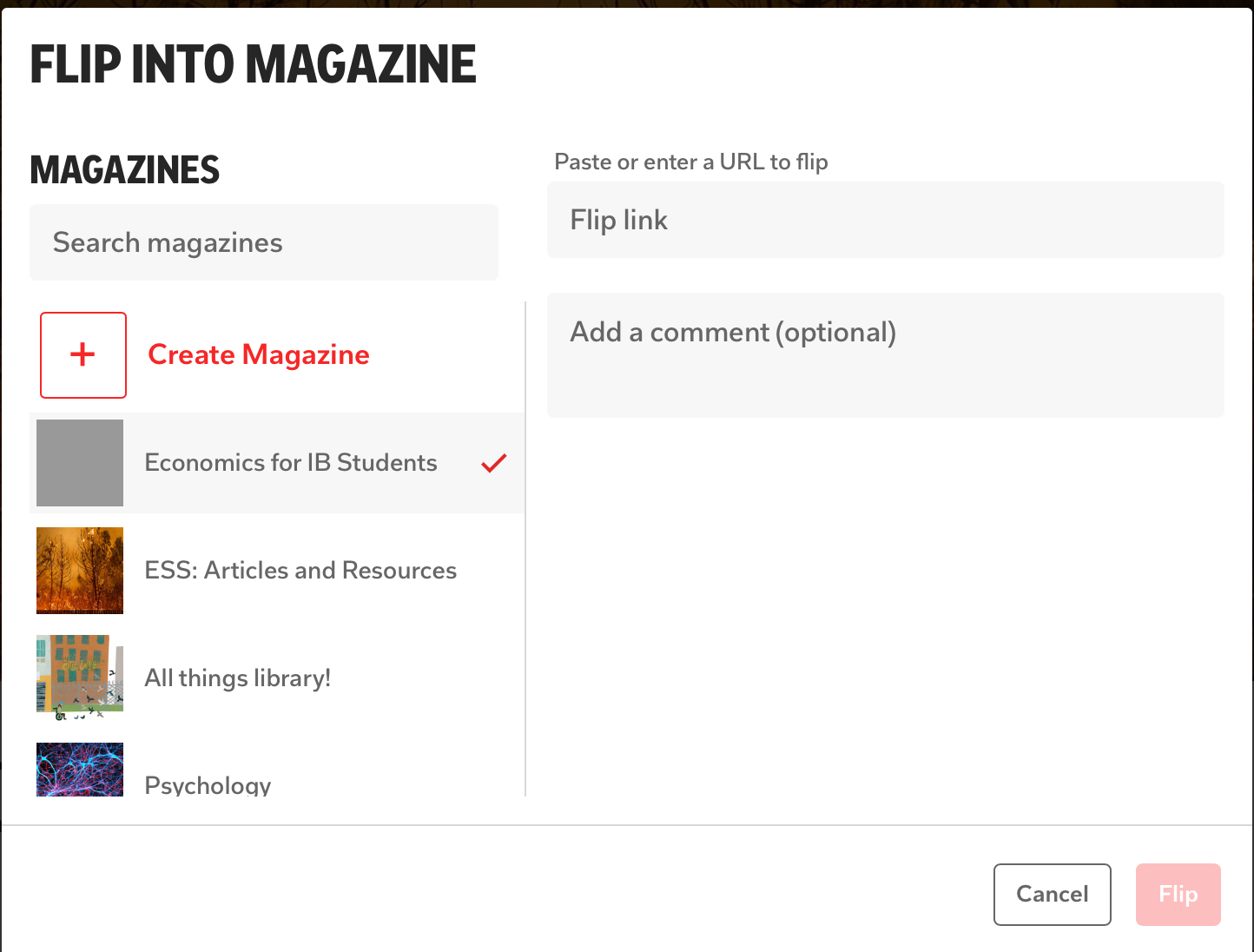
For those of you who haven’t encountered Flipboard yet, it is a social bookmarking site which allows you to curate articles, which appear on a page in a grid format.  


All you need to do is click on the image and you are taken to the article.  The curator is also able to write comments about the article they are ‘book marking’.


There are quite obvious uses for Flipboard.  I used to send links to teachers and administrators, relating to their subject area and/or interests.  However, as all educators know, we receive far too many emails.  When I came across Flipboard I realised that it was a way to cut down on the number of emails I was sending and that teachers were receiving.  I think that I expected teachers to sign up to follow the Flipboard relating to their subject area, but that proved not to be the case.  I need to try again to encourage them to do so.  I wonder if they have noticed yet that I haven’t been sending emails with links or did they never bother to read my emails in the first place.  Alas!  

Using Flipboard in Education

1. Curating articles for colleagues or students on a particular subject.

2. The ability to add comments about the articles would allow teachers to set a particular activity for the student to do, relating to the articles.  Teachers could ask questions, which might allow them to see how well a student understood what they had read.

3. Students could be given an assignment to curate their own set of articles on a particular topic.  As part of the curation they could be asked to comment on each of the sources they had added.  These comments might include information on the the author and their authority in writing the article; on the origin of the information the author had used (is there a WCL or bibliography); whether or not there was obvious bias.  The list could go on, depending on the aim of the assignment.  Students might also be asked to state what is compelling about the article they have chosen.

3. Each student could be asked to share their Flipboard with another student in the class.  In this way, they could make comments on each other’s sources and also find new sources they hadn’t come across yet.

4. Flipboards are another way for students to make their source lists or WCLs visible to others.  I have created an example for a grade 6 (year 7) science project on forensics.  My imaginary student has chosen to research and write about DNA Fingerprinting;  https://flipboard.com/@merrilibrarian/forensics-dna-fingerprinting-r6cdvnf6z?from=share

5. Teachers could curate their curriculum in a Flipboard magazine, with articles for students to read relating to each unit.

6. I really like this idea but it isn’t mine:  “Record a video of yourself giving out the assignment, upload it to Youtube, pull it into your Flipboard along with two or three articles pertaining to the assignment, and ask students to add two of their own, as well as commenting on two collected by other students. Ask if they can locate an appropriate content expert on twitter and pull that feed in as well. During your class discussion, ask students to converse on a Google Doc, then add that Google Doc to the magazine as well.”  (Homan)

Works Cited
Homan, Audrey. "4 Ways to Use Flipboard in your Flipped Classroom." Innovative Education in VT,     
     12 Sept. 2014, tiie.w3.uvm.edu/blog/4-ways-use-flipboard-flipped-classroom/. Accessed 8 June 
     2020

Wednesday, 18 September 2019

And now Easybib

And so I go back to The Onion and it's wonderful coverage of the declaration of war in 1914 to look at the accuracy of EasyBib's references for this source.

The link to this source is: https://www.theonion.com/august-5-1914-181958824 and the citation from EasyBib is:


The Onion. “August 5, 1914.” The Onion, The Onion, 11 Sept. 2018, www.theonion.com/august-5-1914-1819588242.

I was concerned about three aspects of this reference:
  • Firstly, the Onion is given as a corporate author, despite the MLA 8th edition advice which is as follows: if a corporate author is also the publisher, give it as the publisher and not as the author.
  • Secondly, there is no date of access given.  The MLA 8th edition handbook says: "Since online works typically can be changed or removed at anytime, the date on which you accessed online material is often an important indicator of the version you consulted."  If you are working at an IBO school, you know that students must include the access date.
  • Finally, The Onion is repeated 3 times: once as the corporate author, once as the website and once as the publisher.  Again, the advice is to leave the publisher field blank if the publisher's name is the same as the site (container) name

Below is the Noodletools version following MLA 8th.
"August 5, 1914." The Onion, 3 Aug. 2006, www.theonion.com/august-5-1914-1819588242. Accessed 18 Sept. 2019.


Thursday, 5 September 2019

To Apogee or Not to Apogee!

[Apogee (aka Apogee 2|Citation Creator) is an extension for Chrome which can be used to reference sources and check on their credibility.]


To Apogee or Not to Apogee?  

Well, after investigating this extension to Chrome, I would give a resounding "No!".

I was asked the other day by a student if he could use Apogee 2, a Chrome extention to create his works cited list.  I said no, that he was required to use Noodletools.  However, I did promise to investigate it.

Just in case your students ask you about using it for citing, here is what I discovered. I added the app and then went into the settings.  The first thing to note is that Apogee tells the user that MLA 8 is not as popular as MLA 7.  In fact, not many people are using it.  I don't know about you but my school has been using it since it was first introduced.  


Next, I chose a web page that a student had recently used in his research.


Apogee gives its version of the MLA 8 reference but unfortunately it isn't correct.  Note the following mistakes:


  1. The author's name is not inverted.  In a Works Cited List the author's last name comes first.
  2. BBC News is included in the author's name.
  3. The title of the article is completely wrong.
  4. No date is given, despite the fact that there is one in the article:  20 May 2018.
  5. The access date is given but is wrongly located.


Below is the MLA reference done in Noodletools MLA 8:


Next I looked at the credibility rating for an article which a student mistook for an authentic one from World War One, but which was actually from the Onion, an American satirical website:


This web page received a 100% credibility rating, whereas the BBC article was only given 80%.

I think I will rest my case there for the time being and check in with Apogee in 6 months to see if it has improved.